Sunday, August 17, 2014

Book on Islam and Atheism

God, Islam, and the Skeptic Mind : A Study on Faith, Religious Diversity, Ethics, and the Problem of Evil (Saiyad Fareed Ahmad, S. Salahuddin Ahmad)

 Description from the publisher:

This work addresses several of, if not the most important issues of theology and philosophy today:

  • How do we know God exists?
  • Is faith compatible with science?
  • Why is there evil and suffering?
  • How should we view religious diversity?
  • Is ethical behavior dependent on the existence of God?

    In this book, Ahmad and Ahmad offer, erudite compelling and fresh answers in an accessible language that respond to the challenges presented by the Age of Skepticism and Science. In doing so, the authors provide a balanced approach representing not only theistic and atheistic perspectives, but also a much-needed Islamic point of view that has largely been ignored or misunderstood.
  • http://www.islamicbookstore.com/b9466.html#scProductReviews

    http://www.mphonline.com/books/nsearchdetails.aspx?&pcode=9789834129415


    Read ebook online from 

    http://www.scribd.com/doc/232402121/God-Islam-And-the-Skeptic-Mind

    Monday, August 11, 2014

    Secularism

    What is secularism?
    Praise be to Allah. Secularism is a new philosophy and a corrupt movement which aims to separate religion from the state, and focuses on worldly matters, and worldly desires and pleasures; it makes this world the only goal in life, and forgets and ignores the Hereafter. It pays no attention to deeds pertaining to the Hereafter. The words of the Prophet (blessings and peace of Allah be upon him) may be applied to the secularist: “Wretched is the slave of the dinar and the slave of the dirham and the slave of the khameesah (a kind of luxurious garment made of wool with patterns). If he is given he is pleased and if he is not given he becomes discontent. May he be wretched and doomed, and if he is pricked with a thorn may it not be pulled out (i.e., may he have no help to remove it).” Narrated by al-Bukhaari (2887). 
    This description includes everyone who criticizes anything of the teachings of Islam in word or deed. The one who rules according to man-made laws and abolishes the rulings of sharee‘ah is a secularist; the one who permits forbidden things such as adultery, alcohol, music and usurious (riba-based) transactions, and believes that forbidding them is harmful to people and is narrow-mindedness which causes people to miss out on some benefits, is a secularist. The one who ban or objects to the carrying out of hadd punishments such as executing the murderer and stoning or flogging the adulterer and the drinker of alcohol, or cutting off the limbs of the thief or bandit, and claims that carrying out these punishments is inhumane, or that it is cruel and abhorrent, also comes under the heading of secularism.
    With regard to the Islamic ruling concerning them, Allah, may He be exalted, says, describing the Jews (interpretation of the meaning):
    “Then do you believe in a part of the Scripture and reject the rest? Then what is the recompense of those who do so among you, except disgrace in the life of this world”
    [al-Baqarah 2:85]
    Whoever accepts whatever suits him of the religion, such as laws on personal and family matters, and some acts of worship, and rejects whatever does not suit him, is included in this verse. 
    Similarly, Allah, may He be exalted, says (interpretation of the meaning):
    “Whosoever desires the life of the world and its glitter; to them We shall pay in full (the wages of) their deeds therein, and they will have no diminution therein.
    They are those for whom there is nothing in the Hereafter but Fire; and vain are the deeds they did therein. And of no effect is that which they used to do”
    [Hood 11:15-16].
    The aims of the secularists are focused on worldly accumulation and pleasures, even it it is haraam and even if it prevents them doing the obligatory duties. Thus they are included in this verse and in the verse in which Allah, may He be exalted, says (interpretation of the meaning):
    “Whoever wishes for the quick-passing (transitory enjoyment of this world), We readily grant him what We will for whom We like. Then, afterwards, We have appointed for him Hell, he will burn therein disgraced and rejected, ( far away from Allah’s Mercy)”
    [al-Isra’ 17:18].
    And there are other similar verses and hadeeths. And Allah knows best.
    Shaykh ‘Abdullah ibn Jibreen (may Allah have mercy on him).

    http://islamqa.info/en/121550

    Tuesday, May 6, 2014

    How can Allaah will and desire what is not pleasing to Him?

    Allah may dislike something, but this does not counter His willing that thing for another purpose as it will be a cause for something that is beloved to Him. For example, Allah created Iblees. He is the being of wickedness in ways of life, actions, beliefs and volitions. He is the cause of many human beings' unhappiness and for their actions that are displeasing to Allah. He is the deliverer of the acts that are in opposition to what Allah loves and is pleased with. At that same time, though, he is a means for many things that Allah will love to bestow on His creatures. Therefore, his existence is more beloved to Allah than his non-existence. This is true for many reasons, including the following:

    Firstly, by creating Iblees, Allah demonstrates to His servants His ability to create opposites and contraries. He has created a being that is the most wicked and the cause of every wickedness. Yet, at the same time, He created his opposite, the angel Gabriel. Gabriel is one of the most noble of all creatures and a source of only good. Blessed be the Creator of the latter and the former. Similarly, this power of Allah's is demonstrated in His creation of night and day, disease and cure, life and death, right and wrong, good and evil. This is part of the detailed evidence of His perfect power, absolute authority, dominion and rule, for He has created those opposites. They are set up against one another. He has used them for meeting His goals. If the world were devoid of these opposites, we would not have witnessed the faultless wisdom, the
    absolute power and the perfect rule He has over all things.

    Secondly, Iblees enables the manifestation of such names (and attributes) of Allah as the Dominant, the Avenger, the Just, the One Who chastises, Who is strict in punishment, Who is quick to judge, Whose grip is strong, Who brings low, and Who humiliates. These names and actions are all part of perfection. Their objects, therefore, have to exist. If the jinns and humans were similar in nature to the angels, none of these names would have become manifest.

    Thirdly, Iblees makes possible the manifestation of such names of Allah as show that He forbears, forgives, overlooks and forgoes the violations of His rights, and sets sinners free. If He had not created things which He detests but which makes possible the manifestation of these names, these benefits and wisdom would have been lost. The Prophet (r) referred to this point when he said,

    “If you did not sin, Allah would have removed you and put in your place a people who will sin and then ask Him to forgive them that He may forgive them.” (Sahih Muslim, vol. , p. , no. )

    Fourthly, Iblees makes possible the manifestation of the wisdom and knowledge of the One Who is wise and knowing, Who places things in their proper places, and nothing in the wrong place, as is dictated by His wisdom and knowledge. He knows to whom He should give His message. He knows who are fit for it and who will receive it gratefully and who are not fit for it. If undesirable causes were removed because they produced evil consequences, the good things that outweigh these evils would have never been realized. Look at the sun, the moon and the wind. They produce good as well as evil but their good greatly outweighs their evil.

    Fifthly, if Iblees had not been created, a number of things by which men affirm their servitude to Allah would not have occurred. The act of worship. jihad, is one of the most beloved acts of worship to Allah. If all people were Believers, that act of worship would be nullified as well as its consequences of having loyalty and enmity for the sake of Allaah. Similarly, the worship in the acts of commanding good and eradicating evil, in having patience, in going against one’s desires, in sacrificing out of love for Allah, in
    repentance and asking forgiveness, in seeking refuge in Allah from being overtaken by his enemy, and being protected from the evil one's plots, and so on, are all part of the wisdom that the human mind would not have been able to discover (if it had not been for the creation of Iblees).

    (Explanation of Aqeedah at-Tahawee by Ibn Abil-‘Izz)

    Friday, April 25, 2014

    Sincerity

    Riyaa (hidden shirk)

    http://blog.islamiconlineuniversity.com/seeking-sincerity/

    To my disappointment they had returned once again. I have seen no creatures as persevere as the spiders. It had been only a fortnight since I last swept away their creepy dwellings and here they were back again. As I brushed away those tiny quarters my mind went back to yet another home; the home of emotions and intentions.
    Indeed, our heart also requires that we clean it frequently. Riyaa (dissimulation, show-off) creeps in silently and spins its webs in every unheeded nook and cranny. We may start something solely for the sake of Allah Almighty; however Shaitan keeps pitching to sneak his part. We human beings may become negligent but Iblees never misses a chance to deprive us of our good deeds.
    Our Loving Prophet (p.b.u.h) warned us beforehand:
    The thing that I fear most for you is the minor Shirk; Riyaa” (Ahmad in his Musnad).
    In another authentic hadeeth it is narrated that Muhammad (p.b.u.h) said
    “Shall I not inform you of what I fear for you more than the maseeh ud-dajjaal? It is the hidden shirk. It is when a man stands up for prayer, and then beautifies his prayer for another to look at.” [Ibn Majah – The hadeeth is Hasan).
    Whether it is spending all your wealth in a good cause, or giving up your life in the way of Allah, if done for praise and popularity among people, it’ll all go in vain. One did sacrifice and pay the price, but got nothing in return, only because Shaitan was successful enough to rob the sincerity. This indeed is the ultimate loss! Allah (s.w.t) says in The Quran:
    “Say (O Muhammad): "Shall We tell you the greatest losers in respect of (their) deeds? Those whose efforts have been wasted in this life while they thought that they were acquiring good by their deeds! They are those who deny the Ayat (proofs, evidences, verses, lessons, signs, revelations, etc.) of their Lord and the Meeting with Him (in the Hereafter). So their works are in vain, and on the Day of Resurrection,
    We shall not give them any weight.” [Surah Al-Kahf: 103-105]
    Be Vigilant!
    1. Do I ignite up when criticised for an act that I did for Allah?
    2. Do I expect praise for the good that I do?
    3. Do I become angry if people do not thank me, or don’t do me favours in return of what kindness I did to them?
    4. Do I day dream about how one day I will become a ‘famous’ scholar or a ‘popular’ Mujahid etc?
    5. Do I love to brag about how ‘pious’ me and my children are? Do I go about announcing my hasanat (good deeds)?
    6. Are my prayers as lengthy and as beautiful in solitude as they are in front of others?
    7. Do I give some hidden Sadaqah or is it all for the fame?

    These questions highlight some of the symptoms of this disastrous disease. Never should we be in a comfort zone regarding this slippery trap. Riya is subtle indeed like a black ant on a black stone in a dark night.
     Our intentions need constant vigilance. Check them every day before going to bed, before every step, before every deed that you perform. There are a number of things that become routine for us and we don’t keep in mind the fact that we are doing them for Allah. An example is Salah; is it just an exercise or our secret meeting with Allah? Another example is how we deal with the people around us; are we being nice just for the sake of it or do we seek Allah’s pleasure? It is our intentions that change the status of our deeds from mere routine work to deeds of worship. A man naturally provides for his family, however if done with the proper intention it can become a Sadaqah for him.

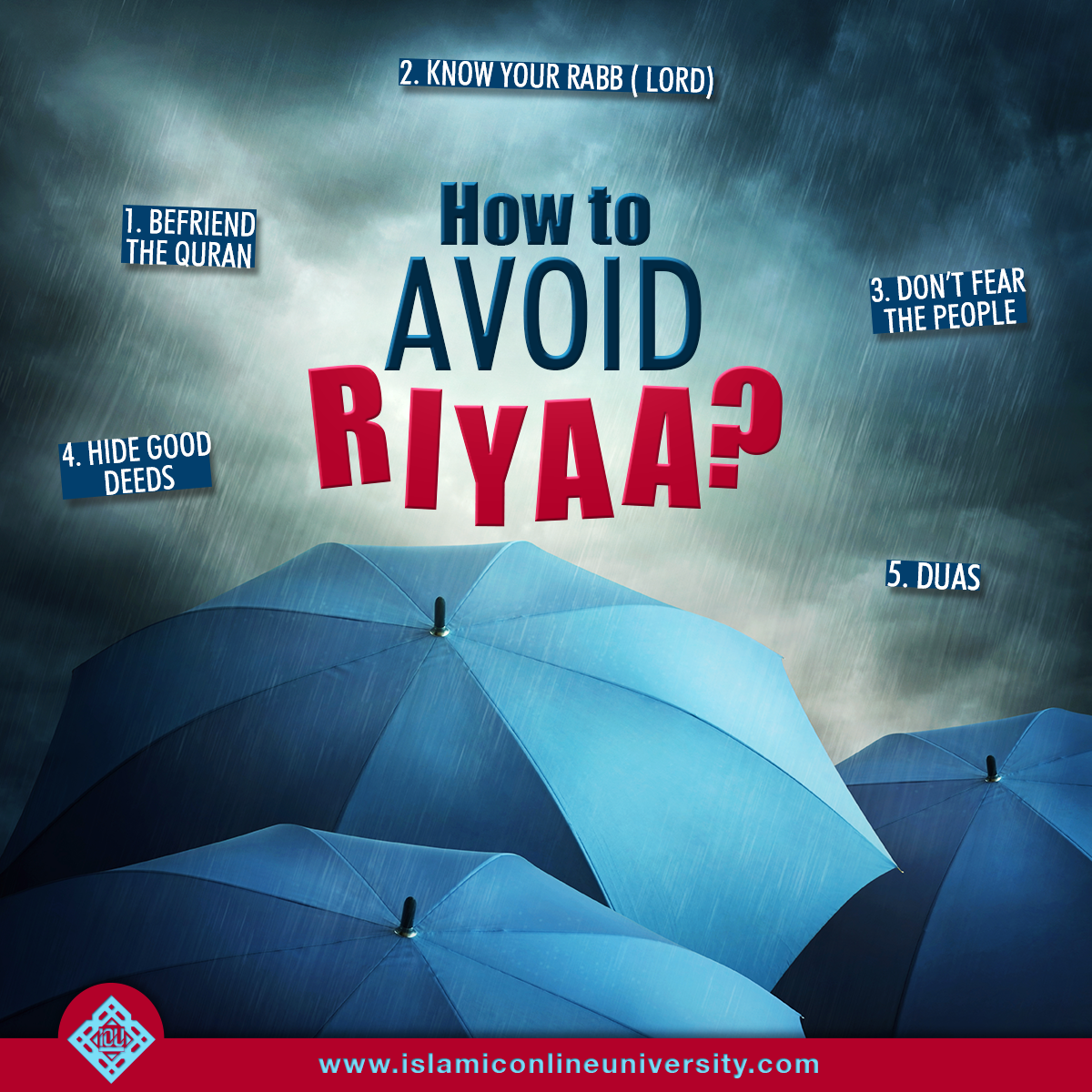
    How to Avoid Riyaa?

    1. Befriend the Quran: As human beings we tend to be forgetful. One of the ways to keep ourselves reminded is holding fast to the Qur’an. The repetitive reminders and remembrance of Allah will strengthen our heart and make us watchful of the traps of Shaitan.
    2. Know Your Rabb: We love to hear the praise of people due to the high status that they have in our hearts. This is because we are not aware and have not yet recognized the greatness of our Creator. His Power, His might, His Knowledge, His beauty and His Love is what should charm us and intrigue us, and create in us the desire to be loved by Him and praised by Him. Ponder over the attributes of Allah and the wonders of His creation. Remember the best gathering that you wished to be mentioned in; that of Allah and the angels!
    3. Don’t Fear the People: At times we do an action or forsake an action just out of the fear of people; their anger and criticism, or only because they might form a bad opinion about us. Remember the real worth of people; they are all from mud and will return to it one day. The approval of people is a myriad; a thing that makes one happy shall anger the other. When one seeks the love and pleasure of Allah, Allah also puts his love in the hearts of creation. However, when one seeks the pleasure of people he gets his hands on nothing.
     4. Hide Good Deeds: Try best to hide your good deeds and perform some secret actions just for the sake of Allah. For example, try and wake up for Qiyam ul lail. It is the best remedy for diseased hearts. It is your special secret meeting that no one else knows about.FB Blog post-4
    5. Duas: Dua is the greatest helper along the path to Paradise. Prophet Muhammad (p.b.u.h) has taught us duas for every occasion and every need.  Repeat this dua often to ward off the hidden shirk that might take roots in the heart:“Allahumma innaa na`oothu bika an-nushrika bika shay`an na`lamuhu, wa nastagfiruka limaa laa na`lamuh. [O Allah, we seek refuge in you from committing shirk knowingly, and ask your forgiveness (for the shirk) that we may commit unknowingly]

    It is not just the quantity that matters, quality matters too. The quality of our deeds rests on the state of the heart. We need to strengthen it and purify it so that our inner self is better and more beautiful than our outer self. Ibn al Qayyim writes in Madarij-us-Salikeen: “Ikhlas(sincerity) is when the servant’s internal and external actions are the same. And Riyaa is when the external actions are better than the internal actions (of the heart). Truthfulness in one’s sincerity is when the internal is better (developed) than the external.”

    Attributes of Allah

    From the book "Radiance of Faith" by Ibn Qudamah,

    The attribute of “Face” is among the essential attributes and it clearly confirmed by this verse whereby it is attributed directly to Allaah in a possessive construction. What is attributed to Allaah is either

    1. a thaat [something actually existing] or
    2. a meaning or concept (ma‘naa).

    The thaats can either exist by themselves as in the case of “Allaah’s camel” and “Allaah’s house” or they cannot as in the case of “Allaah’s face” or “Allaah’s hand”, etc. i.e., faces and hands do not exist by themselves without an owner.

    An example of a meaning is that of mercy and pleasure in the phrases “Allaah’s mercy” and “Allaah’s pleasure”.

    The rule is: If something, which can exist by itself, is attributed to Allaah, it is an
    attribution of honor as in the case of “Allaah’s camel” or “His house”. On the other hand, if the existing being cannot exist by itself, like “Allaah’s Face” or “Allaah’s hand”, its attribution to Allaah implies a description and not something of honor. The people of innovation claim that “Face” here means “the Divine Essence”, i.e., “And the Face of your Lord remains” means “And your Lord remains”. The deviants claim that “face” means “reward”.

    Saturday, April 19, 2014

    Video Series


    Fundamentals of Faith-5:   Proofs of Existence of God.mp4


    Yvonne Ridley - From Captive to Convert (Low)

    Khutbah  With every difficulty there is ease - Yasir Qadhi


    The Names and Attributes of Allah - Yasir Qadhi


    Istikharah How To & Why - Shaykh Abdul Nasir Jangda


    The Meaning of the Tashahhud - Preview of Meaningful Prayer from Bayyinah - AbdulNasir Jangda

                                           
    The Meaning of the Tashahhud


    1914 The Shaping of the Modern Muslim World - Part 1 ~ Dr. Yasir Qadhi  15th January 2014


    1914 The Shaping of the Modern Muslim World pt.2 - Yasir Qadhi & Nabil Bayakli (Jan 19, 2014)


    DeenShow

    I want to have sex. drink and party


    SuperStar Series


                                          Thumaama ibn Athaal 

    Thursday, March 6, 2014

    Questions...


    1. If Allah(swt) is All Merciful then why does He put some people in hell?
    2. What is the difference between Muslims saying that we don't describe the 'how' of Allah (swt) (like how Allah descends to the first heaven at the last part of the night) and Christians claiming that they can't describe the 'how' of their concept of trinity?
    3. We see from the current world that wealth, technology etc. brings happiness, prosperity in our life, then why Islam tells us not to compete for wealth?
    4. If my heart is pure, then I am fine, and I do not need to show people by wearing Hijab, keeping beard etc. type of Islamic symbols. If heart is OK then everything is OK. Why I need to worry about physical symbols? Isn't inner purity important?
    5. Why worshiping Allah is necessary? or Why Allah needs us to worship Him?
    6. Why a Muslim who believes in Islam will eventually go to Paradise even though he has done lots of evil on the other hand why the non-Muslim who does not believe in Islam will go to Hell even though he has done huge good deeds (example Mother Teressa)?
    Answers:
    (5) Allah does not need us to worship Him. He does not get any benefit by worshiping. It is we, the servants of Allah, who get the benefit.

    Think about Salah, Zakat, Siyam, Hajj etc. all forms of worshipping Allah is the commandment of Allah, and abstaining from lie, backbiting, zina, riba etc. are prohibition of Allah. What Allah commands us, it will benefit us and what Allah forbids us, it will remove evil from us.

    If a servant of Allah prays 5 times daily prayer in Jama'a sincerely for Allah subhanataala, he will feel tranquility in his heart, it will make peace in his heart. It will repel evil from heart. Allah said,

    "Indeed, prayer prohibits immorality and wrongdoing." (Al-Qur'an 29:45)

    now, see who gets benefit here, Allah or the servant? every acts of worshiping Allah has benefits to the worshiper.

    (6) How we know that what is good and what is evil? What we see outside may appears as a good, but in fact is it for publicity, showing off, making fame etc. worldly benefit, not for the sake of Allah subhanaataala. What non-Muslim is doing, may be appeared as good, but what hidden motive is behind it only God knows. We can see from outside the good he does. But we do not know the motivation behind it.

    example, voting politics is to show that the candidate is pious person, free sim is for publicity, free food at the opening of any shop or company is the publicity of it etc. everything is for worldly benefit.

    The greatest good one can do is the belief in Allah without partner and belief His last Messenger Muhammad (saw). Even though he has done evil, he will suffer it for sometime in the hell fire. On the other hand, the non-Muslim his good deeds are show off, no real value, he does not have any good deed to get payback from Allah whom he does not believe. He has done good for duniya, and he paid back it in duniya. As he did not do any thing that can benefit him in the hereafter, he will not get anything in hereafter.

    (1) To answer this question, we need to first understand the wider implications of Allah’s attribute of “mercy”.

    Those who enter Hell will either be from among the believers or the disbelievers. As for the believers who enter Hell, they are those who did not associate anything with Allah, but they committed many sins that far outweighed their good deeds. They will enter Hell for a period known only to Allah, then through His mercy they will be made to enter Paradise.

    The Prophet (sallallahu ‘alayhi wassalam) said: “Some people will be brought out of the Fire, having been burnt all over except for their faces, and they will enter Paradise.” [Muslim]

    As Paradise is a place reserved only for the pure, and the impure cannot enter it unless they are cleansed; Allah puts the believers in Hell to purify them of their sins and prepare them to enter Paradise, cleansed. If Allah did not punish them for their sins, then there would be no justice, and the oppressed will not get their due rights. But eventually, as they are believers, the mercy of Allah, i.e. Him being ‘Ar-Raheem’, overpowers and He grants them Paradise.

    Furthermore, the people of Paradise will, at the sight of the people of Hell, be immensely grateful to Allah for saving them and this increases them in thanking Allah.

    Hence, Allah is merciful to the believers by putting them in Hell, not only as a means of purification of their sins but also a means to increase them in gratitude towards Allah for saving them from the eternal punishment, because it is only through Allah’s mercy that anyone can enter Paradise.

    As for the disbelievers who enter Hell, they shall remain in it till eternity. Allah subhanahu wa ta’ala says: “But the ones who deny Our verses and are arrogant toward them - those are the companions of the Fire; they will abide therein eternally.” [Al-A’raf 7:36]

    The reason they will be cast into Hell is stated by Allah Himself in the Qur’an. Allah says: “Indeed, those who do not expect the meeting with Us and are satisfied with the life of this world and feel secure therein and those who are heedless of Our signs, for those their refuge will be the Fire because of what they used to earn.” [Yunus 10:7,8]

    Allah’s mercy can be seen in placing the disbelievers in the Hellfire due to the fact that those same disbelievers were the ones who not only disbelieved in Allah (which is the greatest crime one can commit) but also wronged others. They committed their crimes against Allah, first and foremost, by claiming that He does not exist, or by worshiping partners with Him, which is the only sin that Allah will never forgive. While they were on earth, they also committed crimes against humanity, possibly through fornication, theft, or murder. Therefore, it is merciful to all those that were harmed by the disbeliever that he be sent to the depths of Hell.

    And so, Allah’s attribute of mercy is one that has the element of justice included in it. If Allah were to leave and excuse the disbelievers in the next life, as He had done with them in the Dunya, then it would be open injustice. Moreover, being merciful to one (the wrongdoer) could imply being unjust to another (to whom the wrong has been done).

    Furthermore, it is from Allah’s mercy that the disbelievers lead happy and enjoyable lives in this world, and it will be His mercy that He sends them to the Hellfire, as a reward for the believers.

    Finally, we could also argue that Allah’s mercy is evident in the fact that He did not force any creature to do anything. Although all deeds were written, it was each individual’s choice to perform either good or bad deeds. Therefore, after one has chosen the path of amusement and happiness in this life at the sake of his Hereafter, we can only conclude that it is Allah’s mercy to put him in the place that he chose for himself.

    By refusing to follow his fitrah (natural disposition) that inclines one to believe in the Lordship of Allah, this disbeliever took a path in opposition to that which Allah wanted him to follow. Since he knew that he was doing wrong, harming others, and disbelieving in Allah, and he also knew what the consequences of his actions would be (since it was revealed to him), never considering to repent and return to the path of righteousness; it is only merciful to give him the reward that he chose and not the reward that is reserved for those who are pious.

    And so, Allah is merciful through His justice. This means that because of His justice which is complete justice, a justice that gives everyone exactly what they deserve, no one will be left asking, “what did I do to deserve Hell?”

    The above discussion should make it clear that the mercy, guidance, punishment and misguidance delivered by Allah are not arbitrary at all. Rather, there is divine wisdom behind all of these and Allah is not unjust in His decisions. And Allah knows best.

    Shaykh M. Kamil Ahmed.

    (2) In Islam, it is not permissible to describe the “hows” of Allah’s Attributes because of Allah’s statement: “Allah knows what is [presently] before them and what will be after them, and they will never encompass anything of His Knowledge.” [Taha 20:110].

    The human mind cannot comprehend how Allah’s attributes operate. Taking the names and attributes mentioned in the Qur’an and Sunnah at face value, without any comparison, alteration, negation or takyeef (asking how) is the method of the companions of the Prophet (sallallahu ‘alayhi wassalam), their followers and those who followed their followers.

    A man came to Imam Malik bin Anas and asked him, “O Malik! The Qur’an says that Ar-Rahman ascended the Throne; how did He do that?” Malik was extremely disturbed by this question, and replied:

    “The Istiwaa’ (ascendance) is known [in meaning]; but ‘how’ it took place is not known [to people]. Believing in its occurrence is compulsory; and questioning its mode of occurrence is a bid’ah (a rejected innovation in the Faith). And I believe indeed that you are committing a bid’ah [by asking this question].”

    The man was then banished from his class. [Ad-Darimi and Al-Bayhaqi].

    This example demonstrates the gravity of questioning the “hows” of Allah’s attributes. It also shows that there is support for this argument (not asking about the “hows” of Allah) in the authentic texts of the Sunnah.

    Now, let us examine how the Christians not asking about the “hows” of the Trinity is different from the Muslims not asking about the “hows” of Allah.

    First of all, the Christians’ belief in the Trinity (that God is one in three) clearly contradicts the obvious meanings of their texts. The Bible emphatically states there is only One God:

    “Hear, O Israel: The LORD our God is one LORD.” [Deuteronomy 6:4, Mark 12:29].

    There are many other verses in the Bible that confirms that “God is One”:

    “Know that the LORD is God; besides him there is no other.” [Deuteronomy 4:35]

    “I am the first and I am the last; apart from me there is no God.” [Isaiah 44:6]

    “How can you believe if you accept praise from one another, yet make no effort to obtain the praise that comes from the only God?” [John 5:44].

    The second point is that the Christians do not have any authentic evidence to support their claims. The Trinity that the later Christians have fabricated has no evidence in reason and fitrah (natural disposition), and there is nothing to support it in the divinely-revealed books which Allah sent down.

    Rather, the Trinitarian view of Christianity came into being many years after the disappearance of ‘Isa (‘alayhi salam). Undoubtedly, it was not professed by ‘Isa nor by the other prophets. As a matter of fact, the true followers of ‘Isa (‘alayhi salam) continued to affirm the Oneness of God until about 90 CE. This belief in the Unity of God was manifested in the Shepherd of Hermas, which was written during this period and regarded as a book of revelation by the earlier Christians. More specifically, the first of these commandments states: “First of all, believe that God is One and that He created all things and organized them out of what did not exist made all things to be, and He contains all things but alone is Himself uncontained.” [E. J. Goodspeed, the Apostolic Fathers, 1950; quoted by Muhammad Ata ur-Rahman, op. cit., 1984, p.46].

    Prior to 200 CE, the term “Trinity” (which is now the nucleus of the Christian tenets) was not at all known to the Pauline (Roman Catholic) Church. The early Unitarian leaders were courageous enough to expose their views to refute the Trinitarian dogmas, in spite of the persecution campaign against them. Their real champion, however, was Arius who in 318 CE popularly opposed the Pauline view that ‘Isa (‘alayhi salam) was in reality the “Son of God” and “con-substantial and coeternal with the father”. One of the arguments propagated by Arius was: “If Jesus was in reality the ‘Son of God’, then it followed that the father must have existed before him (the son). Therefore, there must have been a time when the son (Jesus) did not exist. Therefore, it followed that the son was a creature composed of an essence or being which had not always existed. Since God is in essence eternal and Ever-existent, Jesus could not be of the same essence as God.” [Muhammad Ata ur-Rahim, Jesus: Prophet of Islam, p.88].

    In 321 CE, Arius popularly confronted Bishop Alexander the forerunner of the Pauline Church. In 325 CE, Emperor Constantine convened the First General Council at Nicaea. This Council was attended by 318 bishops from Spain to Persia.

    In 380 CE, Emperor Theodosius of Rome made the orthodox faith (the Trinitarian-based Catholic faith) obligatory for all his subjects, hence the state religion since then. By 383 CE, Theodosius threatened to punish all who would not believe in the doctrine of Trinity. Thus, the concept of the Trinity is foreign to the teachings of Christianity. It was a man-made innovation.

    Furthermore, the word “Trinity” is not found in the Bible, and no single verse provides a summary of the Trinitarian doctrine. Actually, it must be remembered that the Old Testament was written before the revelation of the doctrine of the Trinity was clearly given, and in the New Testament after it. How then can the absence of such an allegedly profound doctrine not be found in scared texts? Surely these are ample proofs illustrating that there is no authentic text to support the concept of the ‘Trinity’ in Christianity.

    Finally, Allah has refuted the concept of the Trinity in the Qur’an:

    “They have certainly disbelieved who say, "Allah is the third of three." And there is no god except one God. And if they do not desist from what they are saying, there will surely afflict the disbelievers among them a painful punishment.” [Al-Ma’idah 5:73].

    And so it is quite clear, that questioning about the “hows” of the Trinity cannot be likened to questioning the “hows” of Allah’s attributes. The Trinity is itself an innovation, which makes it questionable; whereas, Allah’s attributes are confirmed by Himself, which we are supposed to believe without questioning, since the human mind can never comprehend the takyeef (asking ‘how’) of Allah’s attributes. Something which is confirmed by the Creator Himself and mentioned in a way that befits Him needs no further questioning.

    Hence, the difference between the two “hows” is that the Muslims’ reason is based on authentic texts, which do not contradict the Qur’an (our text); whereas it is the opposite for the Christians. And Allah knows best.

    Shaykh M. Kamil Ahmed.

    Saturday, July 2, 2011

    Dua to one who snizzes

    Source: http://reviveasunnah.wordpress.com/2010/09/24/responding-to-one-who-sneezes/

    Responding to one who sneezes

    Narrated by Abu Hurayrah (رضي الله عنه) who said that the Prophet (صلى الله عليه وسلم) said,
    “If anyone of you sneezes, he should say ‘Al-Hamdulillah’ (Praise be to Allah), and his (Muslim) brother or companion should say to him, ‘Yarhamuk Allah’ (May Allah bestow his Mercy on you). When the latter says ‘Yarhamuk Allah’, the former should say, ‘Yahdikumul-lah wa Yuslih balakum’ (May Allah give you guidance and improve your condition).”
    [Bukhari: Book 8,Volume 73, Hadith 243]
    Abu Hurayrah also reported in another narration the Messenger of Allah (صلى الله عليه وسلم) saying,
    “Six are the rights of a Muslim over another Muslim. It was said to him: Allah’s Messenger, what are these? Thereupon he said: When you meet him, offer him greetings;when he invites you to a feast accept it. when he seeks your council give him, and when he sneezes and says:” All praise is due to Allah,” you say ‘Yarhamuk Allah’ (may Allah show mercy to you) ; and when he fails ill visit him; and when he dies follow his bier.
    [Muslim: Book 26, Hadith 5379]
    The Prophet (صلى الله عليه وسلم) said, “Allah likes sneezing and dislikes yawning, so if someone sneezes and then praises Allah, then it is obligatory on every Muslim who heard him, to say: May Allah be merciful to you (‘Yarhamuk Allah’). But as regards yawning, it is from Satan, so one must try one’s best to stop it, if one says ‘Ha’ when yawning, Satan will laugh at him.”
    [Bukhari: Book 8, Volume 73, Hadith 24]

    Dua during rainfall

    Source: http://reviveasunnah.wordpress.com/2010/10/02/supplication-during-rainfall/

    Supplication during rainfall

    It is narrated on the authority of Aisha (radiAllahu anha) who said that when the Messenger of Allah (salAllahu alayhi wasalam) saw rain he would say:
    Allahuma sayyiban naafi’an
    (Oh Allah make it a beneficial rain cloud )
    [al Bukhari 1032]
    It is also from the Sunnah to supplicate to Allah during the rain, as this is one of the times when your supplication is more likely to be answered.
    Narrated Sahel Ibn Sa’ad (radiAllahu anhu): that the Messenger of Allah (salAllahu alayhi wasalam) said: ‘Two will not be rejected, Supplication when the Adhan (call of prayer) is being called, and at the time of the rain’.
    [Al-Hakim 2: 114, and Abu Dawud #2540, ibn Majah]
    ‘Seek the response to your du’as when the armies meet, and the prayer is called, and when rain falls’
    [reported by Imam al-Shafi' in al-Umm, al-Sahihah #1469]

    Thursday, June 30, 2011

    How a Pearl Develops

    How a Pearl Develops: A Khutbah for Muslim Women

    by Muhammad Alshareef

    When news of the Christian army that had prepared on the horizons to wipe out Islam reached Abu Qudaamah Ash-Shaamee, he moved quickly to the mimbar of the masjid. In a powerful and emotional speech, Abu Qudaamah ignited the desire of the community to defend their land – jihaad for the sake of Allah. As he left the masjid, walking down a dark and secluded alley, a woman stopped him and said, "As salamu alaykum wa Rahmatullaah!" Abu Qudaamah stopped and did not answer. She repeated her salam again, adding "this is not how pious people should act." She stepped forward from the shadows. "I heard you in the masjid encouraging the believers to go for jihaad and all I have is this…" She handed him two long braids. "It can be used for a horse rein. Perhaps Allah may write me as one of those who went for jihaad."

    The next day as that Muslim village set out to confront the crusader army, a young boy ran through the gathering and stood at the hooves of Abu Qudaamah's horse. "I ask you by Allah to allow me to join the army."

    Some of the elder fighters laughed at the boy. "The horses will trample you," they said.

    But Abu Qudaamah looked down into his eyes as he asked again, "I ask you by Allah, let me join."

    Abu Qudaamah then said, "On one condition; if you are killed you will take me with you to Jannah amongst those you will be allowed to intercede for."

    That young boy smiled. "It's a promise."

    When the two armies met and the fighting intensified, the young boy on the back of Abu Qudaamah's horse asked, "I ask you by Allah to give me 3 arrows."

    "You'll lose them," said Abu Qudaamah.

    The boy repeated, "I ask you by Allah to give me them."

    Abu Qudaamah gave him the arrows and the boy took aim. "Bismillah!" The arrow flew and killed a Roman. "Bismillah!" The second arrow flew, killing a second Roman. "Bismillah!" The third arrow flew, killing a third Roman. An arrow then struck the boy in the chest, knocking him off the horse. Abu Qudaamah jumped down to his side, reminding the boy in his final breaths, "Don't forget the promise!"

    The boy reached into his pocket, extracted a pouch and said, "Please return this to my mother."

    "Who's your mother?" asked Abu Qudaamah.

    "The women that gave you the braids yesterday."


    Think about this Muslimah. How did she reach this level of taqwa where she would sacrifice her hair and her son? Indeed, she spent her life in the obedience of Allah, and when exam time came, she passed. Not only did she pass herself, but her children shone with that same beauty of eman; children that she herself raised.

    Most often the lectures, khutbahs, and talks are all directed to the Muslim men. We forget that from the hady (guidance and way) of RasulAllah sal Allaahu alayhi wa sallam was that he would allocate a specific day of the week to teach the women. Women would come up to him in Hajj, in the street, and even in his home to ask him questions about the deen. At the Eid salah, after addressing the men, he would take Bilal and go to the women’s section and address the women. Allah revealed an entire surah by the name of An-Nisaa’ (The Women), another by the name of Maryam (Mary), and yet another by the name of Al-Mujaadalah (The Woman Who Pleads). It is in enlivening this Sunnah that today this speech shall be addressed to the believing women – al-mu'minaat.

    Dear sister, dear mother, and dear daughter, everyone is looking for happiness and fun, and I am sure that you are not excluded. Where is that happiness and fun though? And where and when do you want that happiness? Do you want to have ‘fun’ in this life at the expense of the hereafter? Or is it in the hereafter, when you meet Allah, that you want to be happy?

    Everywhere you go you shall find a swarm of people, media, and culture swearing to you that happiness is the happiness of the dunya. Is it really happiness though? On the Day of Repayment, Allah shall take the most ‘happiest’ kafir of the dunya and dip him in Jahannam (Hellfire). Then He shall ask him, "Have you ever seen any happiness?" The Kafir will say, "Never!"

    Nay, the happiness is only the happiness of the hereafter no matter what happens in this dunya. Allah shall bring on the Day of Repayment the most tested human and dip him in Jannah (Paradise). He shall then ask him, "Have you ever seen sadness?" And that person shall say, "Never!"

    And don't think that this happiness and fun is exclusive to the Hereafter. It is very much tied to this life as well. Listen and understand the words of Allah:

    Whoever works righteousness, whether male or female, while he [or she] is a true believer, verily to him We will give a good life [in this world with respect, contentment and lawful provision], and We shall pay them certainly a reward in proportion to the best of what they used to do [i.e. Paradise in the Hereafter] (An-Nahl 16/97).

    Dear sister, you have to understand that you or anyone may enter Hellfire. By Allah, we are not better than Fatimah, the daughter of Rasul Allah sal Allaahu alayhi wa sallam. And he said to her, "O Fatimah, the daughter of Muhammad, ssk me whatever you wish from my wealth, for I shall avail you nothing to Allah." Meaning that it doesn't matter if you're my daughter; if you don't work for Jannah, saying to Allah that my father is so and so will not help you in any way.

    Islam is filled with many mu'minahs who completed their taqwa of Allah. When the other girls put up posters of kafir singers, athletes and actresses, you should put up posters in your heart of Fatimah and many other mu'minahs.

    One of these women was Aasiyah, the wife of Fir'own. Her eman in Allah thrived under the shadow of someone who said, "I am your Lord, Most High!" When news reached Fir'own of his wife's eman, he beat her and commanded his guards to beat her. They took her out in the scalding noon heat, tied her hands and feet, and beat her perpetually. Who did she turn to? She turned to Allah! She prayed, "My Lord, build for me a home with you in Paradise, save me from Fir'own and his deeds, and save me from the transgressive people."

    It was narrated that when she said this, the sky opened for her and she saw her home in Paradise. She smiled. The guards watched astonished – she's being tortured and she smiles? Frustrated, Fir'own commanded a boulder to be brought and dropped on Aasiyah to crush her to death. But Allah took her soul before the boulder was brought and she became an example for all the believing men and women till the end of time:

    And Allah has set forth an example for those who believe: the wife of Fir'own [Pharaoh] when she said, "My Lord, Build for me a home with You in Paradise, and save me from Fir'own and his deeds, and save me from the transgressive [disbelieving people] (At-Tahreem 66/11).

    When we talk about jihaad and shuhadaa' (martyrs), do you know who the first Muslim in Islam to be killed in the path of Allah was? It was Summayah, the mother of Ammar. When Abu Jahl heard of her, her husband Yaasir, and her son Ammar’s Islam, he whipped them all and beat them, so much so, that RasulAllah would pass by them as they went through this test of their eman and would say to them, “Be patient, O Jannah!”

    One day, as Abu Jahl beat Sumayyah, she refused to recant her deen; something that enraged Abu Jahl. He took a spear as she lay on the burning sand looking up to the sky, and he speared through her midsection. She was the first of her family and the entire ummah to meet Allah as a martyr.

    Dear sister, our role models come from the Qur’an. You may have heard the story of the boy and the king. When the entire village became Muslim by the death of that young boy, the king ordered that an enormous fire be kindled and all those who would not recant their religion be burned alive. A mu'minah, stood with her baby over the fire. She looked at her baby, and seeking her child's weakness and innocence, she considered turning her back. The baby said to her, "What are you waiting for mother. Go forward, for you are on the truth!" She nodded. Then, with her baby in hand, she was pushed to her death.

    And they ill-treated them for no other reason than that they believed in Allah, exalted in power, worthy of all praise! / Him to Whom belongs the dominion of the heavens and the earth! And Allah is witness to all things (Al-Buruj 85/8-9).

    And dear sister, your role models can also come to you from today. As her son tells us, a senior woman in a Muslim land decided that all the vanity that normally happens in the gatherings of women was not for her. She turned to salah and praying at night, and in her old age, she found herself calling to her son one night from her prayer room. He son says, "I came in and she was in sajdah saying that she was paralyzed!" Her son took her to the doctors and she began a cycle of rehabilitation, but there was little hope. She then commanded her son to take her back home, back to her prayer room, back to that sajdah. As she prayed to Allah in her sajdah, the night came and she again called to her son. "Astawdi'ukallaah alladhee laa yadee'u wa daa'i'uh," which means, "I leave you in the trust of Allah, and whenever something is left in Allah's trust it is never lost." She passed away in her sajdah. Her muscles froze in that position and so they had to wash her body as she was in sajdah. They prayed janazah for her as her body was in sajdah. They carried her to the graveyard as her body was in sajdah. They buried her as she was in sajdah. The Prophet sal Allaahu alayhi wa sallam said that we shall all be resurrected on what we died on; she shall be resurrected on the day of Judgment in sajdah to Allah – jalla jalaaluhu wa taqaddasat asmaa'uhu - because that it how she lived and died.

    There are many other stories that we know about of powerful believing mothers, wives and sisters, and many that Allah only knows about. Whenever a halaqah is going on, the Muslim women outnumber the men. Go to an Islamic teachers or schools conference, attend a lecture and you shall see the mismatch of sisters to brothers. Sometimes it is sad to see all these brothers lacking the motivation that many muslimahs have. But if there is a beautiful sign in all this, it is that, in sha Allah ta'aala, those sisters are going to raise an army of believing men and women in the coming generation, wAllahu Akbar!

    When Imam Ahmad was still young, his father died. He would tell his students of the work his mother went through in raising him, and he would pray for her. In the cold Baghdad nights, she would wake long before him to warm the water so that her son Ahmad could make wudu for Fajr. Then she would wrap him in blankets, she herself cloaked in her jilbaab. She would guide him through the dark, cold alleys to reach the main masjid long before Fajr so that her son could get a good seat in class. Her son Ahmad, at that age in grade 2 or 3, would sit all day long studying Qur’an and Sunnah, and she would wait for him to finish so that she could drop him home safely. At the age of 16, she prepared money and food for him and told him, "Travel for your search of knowledge." He left for Makkah and Madinah and many other places, and met many great scholars. She raised Ahmad to become one of the four greatest imams in Islam.

    PART II

    Dear sister, after all this, ask a non-Muslim what it is that he wants from you. Does he want you to be liberated? Liberated from what? From Allah and his Messenger? From the Qur’an and the Sunnah? From Jannah? From this deen that Allah chose for you?

    And what is he going to give you in return? Happiness? By Allah, he does not own any happiness to give. Is he going to give you love and protection from punishment in the grave and from the gatekeepers of Hellfire and from death? Why is it that they want to liberate young beautiful women? Why don't they liberate the seniors? Why don't they liberate the indigenous? Why don't they liberate the inmates? Why is their target audience a young, skinny and tall woman (their definition of beauty) between the ages of 13 – 28? And why is their first call for you to take off your hijab?

    Remember that friend – if you consider him so – carefully, for without any doubt, by Allah, he shall be your bitterest enemy on the Day of Repayment.

    Friends on that day will be foes, one to another – except the Righteous (Al-Zukhruf 43/67).

    One kafirah summed up exactly what they think of women, "It's not who you are, it's what you wear and what you look like!" And listen to Fabian, a French 'model,' as she spit on the fashion industry. "Fashion houses made me into a mannequin, a wooden idol. The mission: to manipulate hearts and alter minds. I learned how to be worthless, nothing on the inside, but cold. We lived in a world of filth."

    When the Prophet sal Allaahu alayhi wa sallam stood on the plain of Arafah and gave his farewell speech, he said to the ummah, "Treat the women kindly!" History records that in Europe, in the same year, at the same time that Islam was saying this, the Christian clergy were arguing whether a woman was a human or an animal! Those clergymen are the ancestors of the kuffar that now want to 'liberate' you.

    There is much more than can be said. I shall conclude with the advice of RasulAllah sal Allaahu alayhi wa sallam to every Muslim mother, daughter, and wife:

    "If the woman prays her five (salah), fasts her month (of Ramadan), protects herself (from committing zina), and listens to her husband, it will be said to her, that from any door you wish, enter Paradise!"

    O ye who believe! Give your response to Allah and His Messenger, when He calls you to that which shall give you life; and know that Allah cometh between a man and his heart, and that it is He to Whom ye shall [all] be gathered (Al-Anfal 8/24).

    Allah and His Messenger are calling you to life. Dear sister, reply!

    Dua after wudu

    Source: http://reviveasunnah.wordpress.com/

    ‘Umar bin al-Khattaab, radiallahu ‘anh said: The Messenger of Allah sallallahu ‘alayhi wa salam said:
     ”None of you perfects his wudu (ablution), then says:
     ‘I bear witness that none has the right to be worshipped except Allaah, alone, without partner, and I bear witness that Muhammad is His slave and Messenger.’
    except that the eight gates of paradise open for him, and for him is to enter it from wherever he wants”
     [Muslim: 553]

    Other supplications that can be made after completing wudu:

    ‘How perfect You are O Allaah, and I praise You, I bear witness that none has the right to be worshipped except You, I seek Your forgiveness and turn in repentance to You.’
    ‘O Allaah, make me of those who return to You often in repentance and make me of those who remain clean and pure.’

    Saturday, June 25, 2011

    Seven People will get shade of Allah in the day of judgment


    Narrated Abu Huraira:

    The Prophet said, "Allah will give shade, to seven, on the Day when there will be no shade but His.
    (These seven persons are)

    1. a just ruler,
    2. a youth who has been brought up in the worship of Allah (i.e. worships Allah sincerely from childhood),
    3. a man whose heart is attached to the mosques (i.e. to pray the compulsory prayers in the mosque in congregation),
    4. two persons who love each other only for Allah's sake and they meet and depart in Allah's cause only,
    5. a man who refuses the call of a charming woman of noble birth for illicit intercourse with her and says: I am afraid of Allah,
    6. a man who gives charitable gifts so secretly that his left hand does not know what his right hand has given (i.e. nobody knows how much he has given in charity), and
    7. a person who remembers Allah in seclusion and his eyes are then flooded with tears."

    Related articles:
    http://navedz.wordpress.com/2011/01/23/allah-will-give-shade-to-seven-on-the-day/
    http://www.muslimummah.org/hadith/dispalyAllhadith.php?caption=Riyad-us-Saliheen%A0376&&HadithNo=376%20&&hadithBookID=1003&&itemno=461&&hadithBookID2=1003&&subjectcode=eeal

    Friday, June 24, 2011

    Take Advantage of Five Before Five

    Source: http://www.khutbah.com/en/sunnah_seerah/five.php

    Take Advantage of Five Before Five

    by Yasir Birjas

    The Prophet sal Allaahu alayhi wa sallam has been blessed with jawaami' ul kalim, the most concise, or precise, speech. The Prophet sal Allaahu alayhi wa sallam said, "I have been blessed with concise speech." Therefore, when we look at the precious pearls that came out of the Prophet’s mouth, sal Allaahu alayhi wa sallam, we find that many of his ahadith are in fact treasure chests of wisdom. The words might be small, but the meanings behind them are great. The speech might be succinct, but the benefits and the blessings that can be derived from them are innumerable.

    And of the ahadith that are jawaami', or comprehensive in nature, is the hadith of ibn Abbas radi Allahu anhu reported in the mustadrak of Al-Haakim, musnad Imam Ahmad, and others, with an authentic chain of narration. In this hadith the Prophet sal Allaahu alayhi wa sallam said to a man while he was advising him:

    "Take advantage of five matters before five other matters: your youth, before you become old; and your health, before you fall sick; and your richness, before you become poor; and your free time before you become busy; and your life, before your death."

    The first word, ightanam comes from same root that signifies sheep - ghanam. Sheep, in Arabic, means ghanam, and ightanam is from the same root that also signifies sheep. What exactly is the meaning of ightanam? Ightanam is used to indicate any good that can be obtained without much effort. Just like sheep, they can easily be caught if they go astray. This is why the war booty that is found on the battlefield after the army has fled is called ghaneemah. It is easy to take, just like the sheep. You can grasp it without much effort. Ghaneemah, ightanam, and ghanam are all from the same root.

    So it is as if the Prophet sal Allaahu alayhi wa sallam is pointing out that these five matters are very easy to obtain. They are easy to prey on and catch, and very simple to benefit from. That is because they are treasures that everyone possesses but few people appreciate.

    What are these five things?

    #1: Take Advantage of Your Youth Before Your Old Age

    The Prophet sal Allaahu alayhi wa sallam started off and said shabbab or shab, a youth or young person. The Prophet sal Allaahu alayhi wa sallam said, "Take advantage of your youth before your haram.” And the word haram means old age, maybe even senility. It is an age in which the person does not have the power or mental faculties that he had while he was a youth.

    Youthfulness is a time when a person is the most energetic, when he lays out the foundations for his future, and when he plans his life. So the Prophet sal Allaahu alayhi wa sallam said to take advantage of this time before the time comes when you do not have that enthusiasm, when you do not have that zeal, or that outlook. The enthusiasm and energy that you have been blessed with will never again be given to you after this age. Therefore, the Prophet sal Allaahu alayhi wa sallam said to seize the moment and take advantage of it. A person should exercise this energy for the sake of Allah by procuring knowledge of Allah, obtaining halal sustenance, and worshipping Allah through acts that he might not be able to do later on in life.

    Youth here does not mean the western concept of youth that youthfulness finishes when someone is eighteen or nineteen years old. In the Islamic Shari’ah, a man's life has been divided into a number of sectors or stages. Shabbab or shab, according to the strongest opinion, means before reaching the age of forty. This is because forty is the prime of life, when mental and physical capabilities have reached a peak, and after that they start to go down.

    The Prophet sal Allaahu alayhi wa sallam said:

    "Seven are the people that will be sheltered on the Day of Judgment, the day in which there is no shade except the shade of Allah subhaanahu wa ta ‘aala.

    One of the seven people, the Prophet sal Allaahu alayhi wa sallam mentioned was a youth who grew up in the worship of Allah subhaanahu wa ta ‘aala. Remember, the youth is up to forty. So this young person, whether he is twenty or thirty or right before reaching the age of forty, he has grown up and has been raised or has raised himself busy in the worship of Allah subhaanahu wa ta ‘aala.

    Likewise, the Prophet sal Allaahu alayhi wa sallam said in an authentic hadith that Allah subhaanahu wa ta ‘aala is pleased with and amazed at the youth who does not have any evil inclinations. This means he does not do evil. Allah subhaanahu wa ta ‘aala loves such a youth who is straight in the worship of Allah and does not turn left or right to the paths of Shaytaan. Allah loves this person and is amazed at him because in general it is the youth, due to their virility and strong desires, who swerve left and right away from the path of the worship of Allah subhaanahu wa ta ‘aala. So this is the first of the five: “your youth before your old age.”

    #2: Take Advantage of Your Health, Before You Fall Sick

    The second of the five matters is, "your health, before you fall sick." The fact that one lives a normal life and is not afflicted with diseases and plagues, represents a person’s health. Take advantage of this before diseases and plagues come because mankind, being mankind, will fall sick. Everyone falls sick. If we did not fall sick, we would not be humans, we would be divine.

    There will come a time when we will fall sick. Some of those times the sicknesses will be more severe, and for certain people even more severe. So the Prophet sal Allaahu alayhi wa sallam is reminding us that we do not know when we will have full possession of our faculties, of our strength, of our mental powers, before we will fall sick. Therefore, take advantage of it before that time comes.

    The Prophet sal Allaahu alayhi wa sallam said:

    "There are two blessings the majority of mankind have been deceived concerning." The majority of mankind do not appreciate these two blessings. They are "health," good health, "and free time."

    Once a person came to Yunus ibn 'Ubayy, one of the scholars of the Salaf, and he complained of extreme poverty as he had not been blessed with much. Yunus ibn Ubayy asked him, "Would you be willing to give away your sight for a certain amount of money?" The man said, "No, of course not." Then he asked him, "Would you be willing to give your hands away?" He said, "No, of course not." He asked, "Your feet?" He said, "Of course not." When he finished he said "I see that you have hundreds of thousands of millions of blessings, yet you are complaining of poverty?"

    We have our full faculties, we can see and hear. Look at someone who Allah subhaanahu wa ta ‘aala has tested with blindness. It is a very severe test, and that is why the Prophet sal Allaahu alayhi wa sallam has said in an authentic hadith:

    "There are two things if Allah subhaanahu wa ta ‘aala takes them away from a person and he is patient, he is guaranteed Jannah. These two things are the two eyes."

    In other words, if a person is blind, and we seek Allah's refuge from the physical and the spiritual blindness in this world and in the hereafter, then Allah subhaanahu wa ta ‘aala is testing him. And if he is patient, then Allah will reward him with Jannah.

    How about one who has been blessed not just with eyesight, but with hearing, health, arms, limbs, energy, vitality, enthusiasm, and many other things. Should we not appreciate the blessing from Allah subhaanahu wa ta ‘aala? Do we not realize how sweet health is? It can be used for the worship of Allah. When we are blessed with these bodies, why do we not use them in the worship of Allah?

    The least we can do, brothers and sisters, is the faraa'id (obligatory actions) such as salah five times a day, fasting in Ramadan, and going for the Hajj. All of these require that we use our physical bodies. That is the least that we can do, the bare minimum. Of course, the more that one does, the better it is for him.

    This is the second of the five matters: “your health before you fall sick.”

    #3: Take Advantage of Your Richness Before Poverty

    The third is, "your richness, before poverty." One day we might not have anything, and the next we might have much more than we need. One day, a person might have the best of jobs and the largest of salaries, yet, the next day, something happens and he does not have that job anymore and loses his source of income. So the wise person uses his richness before he becomes poor. He invests for his future.

    As for the investments of this dunya, then the kafir and the Muslim are both the same; they both do that. Even the Prophet sal Allaahu alayhi wa sallam would store staple food items even up to a year. Sometimes he would store barley and grain for a whole year for his family. So this is obviously something halaal as the Prophet sal Allaahu alayhi wa sallam himself did it, and we should do it too. We should make sure we have enough money for our family and our children and ourselves, so we are not poor and we are not beggars. There is no doubt that this is a part of our Shari’ah as well.

    But while we are doing this, let us not forget that we also need to invest for the Akhirah. Should we not think about investing this money so we can pick it and pluck it in the Hereafter when we need it far more than we need it in this world? We need to invest for the real future, our real life after our death.

    The Prophet sal Allaahu alayhi wa sallam once asked his companions, "Who amongst you loves his inheritors' money more than his own money?"

    The meaning of this hadith is that the Prophet sal Allaahu alayhi wa sallam is asking for example, does the father love the money of his son or does he love his own money? Of course, the father loves his own money. Likewise, every person will love his own money more than he loves the money of other people.

    The Sahabah said, "Yaa RasulAllah, all of us love our own money more than we love the money of our inheritors. We all love our own money. We guard it and protect it more than the money of our inheritors.”

    Then the Prophet sal Allaahu alayhi wa sallam said, "Verily, the money that you spend in charity is your money, and the money that you leave behind is the money of your inheritors."


    Ponder over that hadith for a while, how true it is. As for the father who loves his own money more than the money of his son, does he not realize that one day his son will take that very money of his and he will have nothing to do with it? All that is left of his money is what he spent during his life for the sake of Allah, if there was any such money. Any of it spent in charity for the sake of Allah, is money that will be yours permanently. The Arabic word for charity includes zakah, sadaqah, waqf, and any type of monetary good that you did. Everything besides this will go into the hands of your inheritors.

    Remember that feeding your family is an ibaadah if you are doing it for the sake of Allah. If you are doing it for the sake of Allah, you will be rewarded. The Prophet sal Allaahu alayhi wa sallam said that, "A morsel of food," one morsel of food, one handful of food, "if you put it in your wife's mouth, this will be a reward for you on the Day of Judgment." Now everybody, Muslim or non-Muslim, feeds his family. But will everybody be rewarded for that? No. Because only the one who does it remembering Allah, thinking about Allah, and doing it for the sake of Allah will be rewarded.

    Ask yourself if the last time you went shopping, Allah was in your mind? Did you think of doing this for Allah? When you picked up the milk and the bread, was your heart thinking, "Oh Allah, I am buying this food through halaal money, and this is halaal food, because I want to feed my family and this is an obligation that You have put upon me, therefore, I am doing it for your sake." Who amongst us has this in his mind?

    When we say, "That is spent for the sake of Allah," we are not just talking about money, zakah, sadaqah, and charity. Of course, giving in charity is the best thing you can do with your money. But do not forget that the majority of income that we spend, and in fact for the mu'min, all of the income that he spends, can be for the sake of Allah as well. This means thinking of Allah, spending for the sake of Allah, and having the intention of pleasing Allah subhaanahu wa ta ‘aala.

    This is the third of the five things: “your richness, before poverty.”

    #4: Take Advantage of Your Free Time Before You Become Busy

    This is yet another great treasure that every single one of us possesses. Every single one of us must use our free time before we become busy. How much free time do we have and what do we waste it on? Think about it. Think about how much free time all of us have been blessed with. We have hours and hours every day and they go by. What do we waste it on? Primarily, in this country at least, television. It is also wasted on gossip and socialization of which there is no benefit whatsoever, in this world nor the hereafter.

    Remember the hadith of the Prophet sal Allaahu alayhi wa sallam that we just quoted about the two blessings (health and free time) most people have been deceived by. In other words, they don't realize their blessings of health and free time. You may have to work eight hours a day, no problem. Allah subhaanahu wa ta ‘aala has allowed this for you. He has obligated it upon you. When you come home, you have four or five hours, so spend them wisely for the sake of Allah.

    Spending time wisely does not necessarily mean purely religious deeds. But spending your time wisely and even be something in this world. Learn a trade. Learn something that can benefit you in this world and that can benefit other people as well. Islam is a complete way of life, a complete code. Do not forget that all of the acts a mu'min does can be transformed into acts of worship if, and only if, he does them for the sake of Allah subhaanahu wa ta ‘aala.

    Of course that there are religious deeds which are the best deeds to do. Every one of us should recite the Qur'an everyday, even if it's only for five or ten minutes. You should have some relationship with the Qur'an. Every one of us should pray some extra prayers as well, a few sunnahs or the nafls, if not the continual sunnahs that the Prophet sal Allaahu alayhi wa sallam used to pray. This is the most important thing for us to do. But at the same time, do not forget that there can be many acts that can be rewarded if you change your niyyah and do them for the sake of Allah.

    Do not waste your time. The greatest waster of time is the television. You turn it on, and an hour or two go by, and not only have you not gained anything for the Akhirah, you have not gained anything for this world. You have literally killed, murdered your time, and done absolutely nothing with it. And realize that you are lucky if you don't come away from those two hours without any sin. How many are the sins that are in television, with music, and the women, and other things. In my opinion, it is better for a mu'min not to even have this instrument in his house because of the evil that comes from it. Like Allah says about alcohol, the evil that comes from it is more than the good that is obtained from it.

    When you have some free time, take advantage of it. The greatest thing that we can do in this free time is to worship Allah. And one of the greatest acts of worship is to seek knowledge. Take a book out to read, listen to some cassettes, or listen to some CD's. Do whatever you can do to increase your 'ilm. Attend some classes or even visit one another for the sake of Allah subhaanahu wa ta ‘aala. Visit your Muslim brother with the proper Islamic etiquette and adab. This is an act you can do that will pass your time away, and be worthwhile.

    This is the fourth of the five matters: "take advantage of your free time before you become busy."

    #5: Take Advantage of Your Life Before Your Death

    This one phrase summarizes it all: "take advantage of your life before your death." Every one of us has a life. That is why we are here right now. Every one of us without a doubt will die. Allah says:

    You are going to die and they too are going to die.

    And it is as Allah said, the Prophet sal Allaahu alayhi wa sallam passed away and so did the people that opposed him and believed in him. They all have passed away. And the turn came for those after them, and then those after them, until it is our turn.

    The Prophet sal Allaahu alayhi wa sallam therefore reminded us, "Take advantage of your life before your death." This is the greatest of foresight. Hence the Prophet sal Allaahu alayhi wa sallam concluded the hadith with this phrase.

    How are we going to use this life before death comes? As for the kafir, he will totally waste it because he will make this life his goal. He will live only to appease and satisfy every desire of his. Then on the Day of Judgment, he will beg Allah to send him back to this life. Allah describes this in the Quran:

    When death comes to them, he will say, “O my Lord!”

    All of a sudden, when his Lord comes to him he remembers Allah. Whereas throughout all of the years that he lived, Allah was nowhere near him; Allah subhaanahu wa ta ‘aala was the furthest thing from his death. On the Day of Judgment when he is resurrected, he will say:

    Oh my Lord! Allow me to go back so that I may do good in the time that I had left.

    Allah obviously will say, "Kalla” – no. You have only been allowed one life and you will not be able to go back and change that life. For every good you do you will be rewarded, and for every evil you do you will be punished.

    Allah subhaanahu wa ta ‘aala also describes them in the Qur’an as saying on the Day of Judgment:

    O our Lord, we have seen and we have heard. Let us go back to do good deeds; we are now believers.

    They claim to believe in Allah and the Day of Judgment but Allah will not allow this to happen because everyone has only one life. That is what Allah has given and this is what we must make the best of in this world so that we are compensated accordingly in the Hereafter.

    These are the five things that the Prophet sal Allaahu alayhi wa sallam told the man to do. He advised him:

    "Take advantage of five matters before five others: your youth, before your old age; and your health before you fall sick; and your wealth before you become poor; and your free time before you become busy; and your life before your death."

    This hadith deals with responsibility, wisdom, foresight, long-term planning, and good strategy. Every one of us has been blessed with these five blessings. There is no one amongst us who has not been blessed with these five things. So how do we utilize them? What do we utilize them for? Why do we utilize them?

    The wise person is the one who strives to achieve the pleasure of Allah subhaanahu wa ta ‘aala and then expects the best from Allah. The wise one is one who tries to arrive at the goal and then has tawakkul in Allah. Tawakkul does not mean to sit back and say, "Oh, this will happen to me." Rather, you must strive for it. The fool is the one who follows his desires and then presumes that Allah subhaanahu wa ta ‘aala will reward him.

    We ask that Allah subhaanahu wa ta ‘aala makes us amongst those who can ightallim, those who can seize these five things, who can take advantage of them before the five will come. These five matters will inevitably be taken away from us, and substituted by the others that the Prophet sal Allaahu alayhi wa sallam mentioned.

    Wa aakhiru da'waana 'anil hamdulillahi Rab al 'Alameen, wa subhanak Allahumma wa bihamdika wa ash hadu'an laa ilaaha illa ant nastaghfiruka wa atubu ilayk.

    Friday, February 11, 2011

    Virtues of Friday

    Source: http://intuitivemuslima.wordpress.com/2007/07/06/virtues-of-friday/


    Virtues of Friday


    When some of us think of Friday, we sometimes associate this day as “The Day” to sit down on that heavenly lounge chair, sip a nice cup of coffee or tea and lift our feet and know that you could care less what your boss wants you to do. This is the day where all worries from the week have been kicked up to the following Monday or Tuesday or whatever day just as long as you don’t have to think about it on Friday. This is the onset of the great weekend that you’ve been planning for since the beginning of the week. A day of fun, partying, vacationing, or just enjoying the time with family and friends.
    This day has become so popular that there’s even a restaurant that is called TGI Fridays the famous acronym that means ”Thank Goodness it’s Friday”. This is what we sometimes associate with this great day; however, there is a great virtue and significance behing the day of Friday in the Islamic religion.
    The day of Friday in Islam carries many virtues and blessings. This was the day that Adam (pbuh) was created, the day he was placed into Paradise, the day he was sent down to the earth, and Friday was the day that he died. Friday is also a day when our supplications to Allah are answered as long as it isn’t something forbidden. This is also the day where the onset of the last hour will begin.  Allah has made this day the master of all other days to the extent that it is greater to Allah than the days of Al-Fitr and Al-Adha. The Prophet Muhammad (pbuh) has mentioned all these characteristics in the following hadiths.
    It was narrated that Abu Hurayrah and Hudhayfah (may Allaah be pleased with them) said: The Messenger of Allaah (peace and blessings of Allaah be upon him) said: “Allaah led those who came before us away from Friday. The Jews had Saturday, and the Christians had Sunday. Then Allaah brought us and Allaah guided us to Friday. So there is Friday, Saturday and Sunday, and thus they will follow us on the Day of Resurrection. We are the last of the people of this world but we will be the first on the Day of Resurrection, and we will be dealt with before all others.” (Muslim)
    It was narrated from Aws ibn Aws that the Prophet (peace and blessings of Allaah be upon him) said: “The best of your days is Friday. On that day Adam (peace be upon him) was created; on that day he died; on that day the Trumpet will be blown and on that day all of creation will swoon. So send a great deal of blessings upon me, for your blessings will be shown to me.” They said, “O Messenger of Allaah, how will our blessings upon you be shown to you when you have turned to dust?” He said, “Allaah has forbidden the earth to consume the bodies of the Prophets, peace be upon them.”  (Abu Dawood; Classed as saheeh by Ibn al-Qayyim in his comments on Sunan Abi Dawood, 4/273; and classed as saheeh by al-Albaani in Saheeh Abi Dawood, 925.)
     It was narrated that Abu Lubaabah ibn ‘Abd al-Mundhir said: The Prophet (peace and blessings of Allaah be upon him) said: “Friday is the master of days, and the greatest of them before Allaah. It is greater before Allaah than the day of al-Adha and the day of al-Fitr. It has five characteristics: on this day Allaah created Adam, on it He sent Adam down to the earth, on it Allaah caused Adam to die, on it there is a time when a person does not ask Allaah for anything but He gives it to him, so long as he does not ask for anything haraam, and on it the Hour will begin. There is no angel who is close to Allaah, no heaven, no earth, no wind, no mountain and no sea that does not fear Friday.”   (Narrated by Ibn Maajah; 1084; Classed as hasan by Shaykh al-Albaani in Saheeh al-Jaami’, no.  2279) 
    In Al-Bukhari and Muslim it is mentioned that during a specific time during Friday whatever we ask Allah He will grant it to us as long as it’s not forbidden in the religion. Here is the narration of the hadith.
    Abu Hurairah (May Allah be pleased with him) reported: The Messenger of Allah (pbuh) said while talking about the merits of Friday, “There is a time on Friday at which a Muslim, while he (or she) is performing Salat and is supplicating, will be granted whatever he (or she) is supplicating for.” And he (pbuh) pointed with his hand to indicate that this period of time is very short. (Al-Bukhari and Muslim)
    One of the virtues of Friday is the Friday Prayer (Salat Al-Jumuah). This is the best prayer.  It’s significance is so great that there is a whole chapter in the Quran that is named Al-Jumuah. Allah makes mention of the importance of Friday in the Quran where He says in the translation of the meaning:
      O you who believe (Muslims)! When the call is proclaimed for the Salaah (prayer) on Friday (Jumu‘ah prayer), come to the remembrance of Allaah [Jumu‘ah religious talk (Khutbah) and Salaah (prayer)] and leave off business (and every other thing). That is better for you if you did but know!” (Al-Jumu’ah 62:9) 
    This is a day where Allah the All-Merciful forgives our minor sins not just for that day but for a week and an extra three days. This is mentioned in the hadith narrated in Sahih Muslim.
    Abu Hurairah (May Allah be pleased with him) reported: The Messenger of Allah (PBUH) said, “If anyone performs Wudu’ properly, then comes to the Friday prayer, listens to the Khutbah (religious talk) attentively and keeps silent, his (minor) sins between that Friday and the following Friday will be forgiven, with the addition of three more days; but he who touches pebbles has caused an interruption. ” (Muslim)
    Abu Hurairah (May Allah be pleased with him)reported: The Prophet (PBUH) said, “The five daily (prescribed) Salat, and Friday (prayer) to the next Friday (prayer), and the fasting of Ramadan to the next Ramadan, is expiation of the sins committed in between them, so long as major sins are avoided.” (Muslim)
    Another Virtue of Friday is the praying the Fajr prayer in congregation on the day of Friday.
    It was narrated that Ibn ‘Umar said: The Messenger (peace and blessings of Allaah be upon him) said: “The best prayer before Allaah is Fajr prayer on Friday in congregation.” (Al-Jaami 1119) Classed as Sahih by Al-Albaani.
    It is also sunnah to recite Surah Al-Sajdaah in the first rakaah (prostration) and Surah Al-Insaan in the second for the fajr prayer held on the day of Friday as this was mentioned in the following hadith where Abu Hurairah narrated.
    The Prophet (peace and blessings of Allaah be upon him) used to recite in Fajr prayer in Fridays Alif-Laam-Meem Tanzeel (Soorat al-Sajdah) in the first rak’ah and Hal ata ‘ala’l-insaan heenun min al-dahr lam yakun shay’an madhkooran (Soorat al-Insaan) in the second. (Al-Bukhaari, 851; Muslim, 880) 
    Another great virtue of this day is the that if a Muslim dies on the day or night of Friday, Allah will protect them from the trials of the grave.
    It was narrated that ‘Abd-Allaah ibn ‘Amr said: The Messenger of Allaah (peace and blessings of Allaah be upon him) said: “There is no Muslim who dies during the day of Friday or the night of Friday but Allaah will protect him from the trial of the grave.” (At-Tirmidhi) Classed as Sahih by Al-Albaani in Ahkaam al-Janaa’iz, p. 49, 50.
    The Friday Prayer in itself has many blessings and rewards as we will see in the following hadiths that mention not only the importance of attending the jumuah prayer (for men it’s obligatory to attend, but optional for women), but the rewards and the bounty of attending it.
    Abu Hurairah (May Allah be pleased with him) reported: The Messenger of Allah (PBUH) said, “He who takes a bath on Friday, like the bath for ceremonial purity, and then goes (to the mosque), he is like one who offers a camel as a sacrifice to seek the Pleasure of Allah; and he who comes at the second hour is like one who offers a cow to win the Pleasure of Allah; and he who comes at the third hour is like one who offers a ram with horns (in sacrifice); and he who comes at the fourth hour is like one who offers a hen; and he who comes at the fifth hour is like one who offers an egg. And when the Imam ascends the pulpit, the angels (who write the names of those who come to the mosque before the coming of the Imam) close (their record) in order to listen to the Khutbah.” (Al-Bukhari and Muslim).
    Aus bin Aus (May Allah be pleased with him)reported: The Messenger of Allah (PBUH) said, “Among the best of your days is Friday. On that day pray to Allah to exalt my mention frequently, for your such supplications are presented to me.” (Abu Dawud)
     Abu Hurairah (May Allah be pleased with him)reported: The Prophet (PBUH) said, “The five daily (prescribed) Salat, and Friday (prayer) to the next Friday (prayer), and the fasting of Ramadan to the next Ramadan, is expiation of the sins committed in between them, so long as major sins are avoided.”
    (Muslim)
    Allah says in the translation of the meaning: Then when the (Jumu`ah) Salat is ended, you may disperse through the land, and seek the Bounty of Allah (by working), and remember Allah much: that you may be successful.” (Al-Jumuah 62:10)
    The attendance to the Friday Prayer is also written down by angels who stand at every gate of the mosque to write down the names of people in chronological order of their attendance.
    Narrated Abu Huraira: The Prophet said, “On every Friday the angels take heir stand at every gate of the mosques to write the names of the people chronologically (i.e. according to the time of their arrival for the Friday prayer and when the Imam sits (on the pulpit) they fold up their scrolls and get ready to listen to the sermon.” (Al-Bukhari)
    How would anyone want to miss the Friday Prayer knowing that the angels company is there among us and sit and prepare themselves to listen to the Imam’s sermon. Subhanallah, the angels are part of the unseen world, but knowing that they are in our presence is such a beautiful illustration. How could anyone put their personal desires above acts of remembrance of Allah and not attend the Friday Prayer. There is a hadith that mentions what happens to those who become unmindful of this day and what may happen due to their negligence.
     Ibn `Umar and Abu Hurairah (May Allah be pleased with them) reported: We heard the Messenger of Allah (PBUH) saying (while delivering Khutbah on his wooden pulpit), “Either some people (i.e., hypocrites) stop neglecting the Friday prayers, or Allah will seal their hearts and they will be among the heedless.” (Muslim)
    These are just several characteristics, virtues, and blessings of the best day of the week. The day of Friday. Allah and the Prophet Muhammad (pbuh) have told us what a great day this is for all of mankind. A day that is filled with the Mercy of Allah and rewards that will be heavy on our scales inshallah on the Day of Judgement. Inshallah the brothers of our nation also see the significance of attending the Jumuah (Friday) Prayer and will strive to have a perfect attendance.

    May Allah keep us guided and on the straight path, and purify our intentions to make it soley for His sake, and give us the understanding in Islam that we may see its richness and its iron strong foundation so that we may never go astray.
    (If I am right it is from Allah (swt). If I have said anthing wrong it is from me, and I am wrong. I ask Allah for His forgiveness, and mercy. Amin)